The Founder’s Blueprint · the first three weeks free
You can feel it.
You just can’t see it yet.
You call it a busy season. Count how long it has lasted.
Eight taps show where your business leaks. Then twelve practical weeks take it out of your head and onto paper, one Sunday at a time.
Eight questions, one tap each. No sign-up to look.
The mirror
Answer the way your calendar would.
Not the way you would like it to be. Eight questions, one tap each. At the end you’ll see where your business leaks, and where week one would start.
First, where is the business today?
A mirror, not a diagnosis. What you tap stays on this device.
How it happened
You became the whole business.
You were good at the work, so you did the work. Then the selling. Then the invoices, the hiring, the late fixes, the posts at eleven at night. Nobody else was going to. And now the business runs on your hours, your memory and your mood.
- Your hours are the ceiling. The business cannot grow past the edge of your week.
- Your biggest decisions get made tired, late at night, or not at all.
- Your people stop offering, because you’ll redo it anyway.
- You quote low, because there was never time to work out what an hour of you is worth.
- You can’t remember the last week you spent on the work you started this for.
Doing everything yourself feels like commitment. It is the ceiling.
Two kinds of stuck
Which one were you this week?
A business that grows needs three things at once: a reason you can say in one sentence, a strategy that says where and how, and the effort to do the work that matters. Founders get stuck by having one without the others.
Week one · SEED · What you believe
What the work looks like. Four moves, no lectures.
Four parts. Four moves each. No blank page. Every line is yours.
- 1Tap what sounds like you.
- 2Slide to the honest number.
- 3Write one sentence.
- 4Read your four lines.
Example · the four lines you read back
One founder. Three taps. Four lines back.
- Admit it“Hit my numbers” ran your month.
- Don’t fight itYou learned it. Test it.
- Don’t ignore itYou named it. That counts.
- ExactlyThursday night: phone away. Write.
It is Sunday, week three
On paper. Not in your head.
- One task handed over
- Your “enough” written as a number
- Three people asked to buy
- Your five numbers read, not guessed
- One customer signal tested
- A storm rule for the bad week
Levels one to three. Free.
A machine counts your week. It can’t decide for you. That part is yours.
The climb
Twelve weeks. Each one ends with something you can point at.
Every week opens with a promise for Sunday: things that happened, not things you thought about. Tap a camp to read it.
- Weeks 1–5Start with youYou, and the basics of a business
- Weeks 6–9Run the businessInside the business
- Weeks 10–12Grow the marketOutside the business
Week 1 · Free
SEED · What you believe
By Sunday: one old rule tested, one task handed over, your enough as a number, three people asked to buy.
Count it yourself
What another year like this costs.
Two numbers only you know. Drag them to your real week.
Beyond the week you want, every year
780 h
That is 20 of your chosen weeks, every year.
Who got those hours last year, and who went without them?
One protected three-hour block a week takes back 156 of them, every year. Week seven, HOUR, builds that block.
Week one starts by counting where last week went.
Twelve weeks from now
The same business. A different founder in it.
Not promises about revenue. Things you will have done if you do the work. Each one written down, checked on a Sunday, and still there on Monday.
Three Sundays later
What the first three weeks can look like.
Three kinds of founder, three different weeks. The same four moves, and something on paper by the third Sunday. These are illustrations of what the work asks for, not reviews.

Why this exists
I was the business, too.
In my late teens I built made-to-measure kitchens and wardrobes. I loved it. I also did everything myself, and I didn’t watch the money. Orders came late, and the business closed.
Today I mentor founders. The Blueprint is what I wish someone had put in front of me then: the right things to look at, one week at a time, and someone to read them with me.
- Finish week three and book your Boardroom hour with me, for $27. The team and I read everything you wrote first.
- So the hour is spent deciding, not explaining.
- You leave knowing which part of the business is costing you most, why it is that one, and with weeks four and five open.
Alexandru
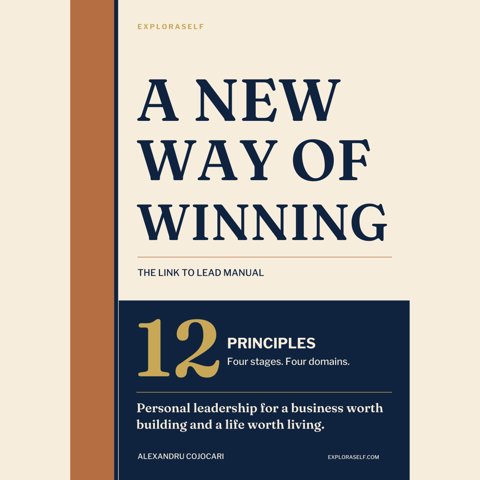 Free with your account: Alexandru’s book A New Way of Winning, the principles the twelve weeks are built on.
What it costs
Start free. Pay only to go higher.
The first three weeks are free and stay free. Finish them, and one hour with Alexandru, $27, opens the next two. That is the whole decision for now.
All four parts of the business, your working notes and your answers, saved and waiting on any device. No card, now or later.
Finish week three and book it. Alexandru names the part of the business costing you most, having read everything you wrote.
Unlock The Boardroom · $27See where the climb goes after week five
All twelve weeks are written. What you choose decides how far you climb and how much of Alexandru is with you. It never decides whether the work exists.
Self-paced, with your second session with Alexandru: two in total. One process somebody else runs, the worth of your hour, and the work you finally put down.
The full twelve weeks, the LAB included, and three sessions with Alexandru in total. A hundred named prospects, your weekly number, and a quarter with dates.
Everything above, all twelve levels open at once, and Alexandru beside you every week: 45 minutes, online.
The whole risk is three weeks of honest work. If the first three weeks don’t show you something about your business you couldn’t see before, stop there. You’ve paid nothing, and everything you wrote is still yours.
Be honest with yourself
Is this for you?
It is, if…
- everything still comes back to you;
- you are building, growing or scaling something real, with customers or close to them;
- you will look at your own calendar, customers and numbers, even when you’d rather not;
- you would rather see the truth than hear a pep talk.
It isn’t, if…
- you want a plan to admire rather than one you run;
- you want a tactic that works without you changing anything;
- you want a course to watch. This is work you do, in your own business, with your own evidence.
I don’t have time for this.
That is usually the symptom, not the reason. Week one starts by counting where your hours actually went, so the first thing it gives you is time you can see. Each week ends with one real thing done by Sunday, at your pace.
Is this personal development or business?
Mostly business. The first of the four parts is you, because in a small business the founder is the first system. The other three are your people, how the work runs, and your market: customers, price and pipeline.
I’ve done courses before. Why would this be different?
A course gives you ideas. Every step here sends you to something real, your calendar, your customers, your messages, and ends in a decision with a date. After week three, a person reads what you wrote.
I work alone. Is “leading people” for me?
Yes. Your people are already there: the contractor, the partner, the client, the family member who covers for you. And the first person you lead is yourself, on a week when nobody is checking.
What does it really cost?
Weeks one to three are free and stay free. No card. The Boardroom hour that opens weeks four and five is $27. After that, the LAB is $97, the HUB is $750, and The Summit, with Alexandru every week, is $1,989. You choose if and when.
Two Sundays from now
The same week, the same fires. Or one thing you can point at.
You already know which one you will get if nothing changes. Start with three free weeks, and see your business from a side you haven’t seen it from.
Start tonight, free. By Tuesday, you’ll be ahead.
Start my free three weeksBy your first Sunday: one task off your desk, your “enough” as a number.
No card. Your work stays yours. Stop any week.